Cart
Your cart is empty
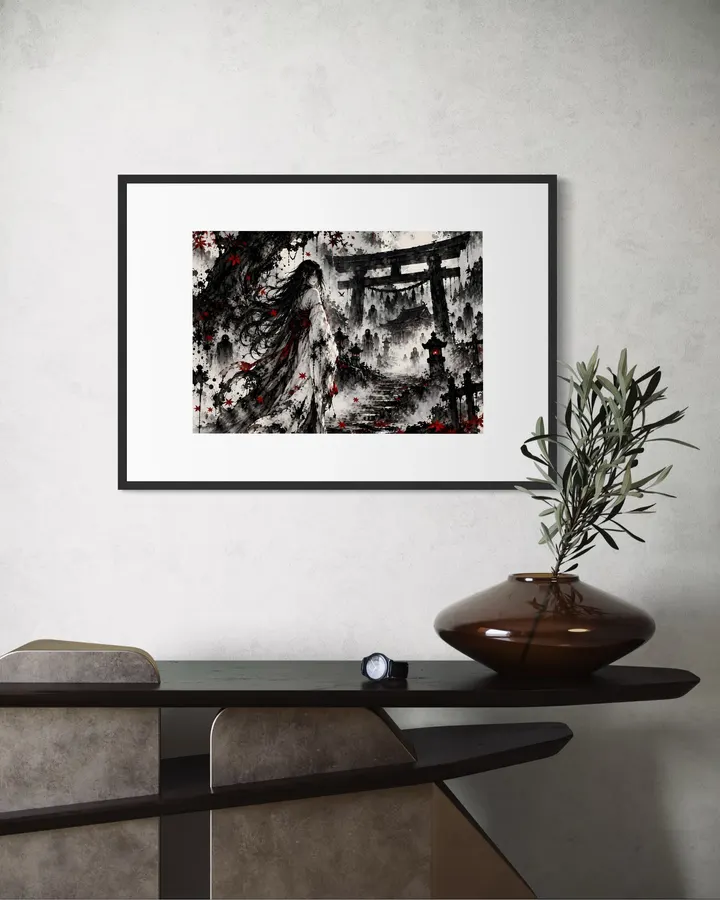
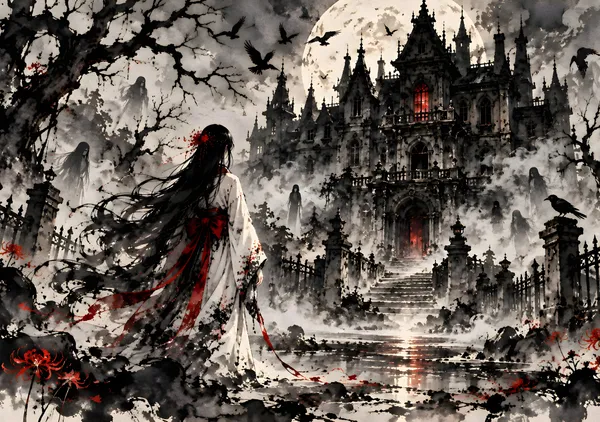
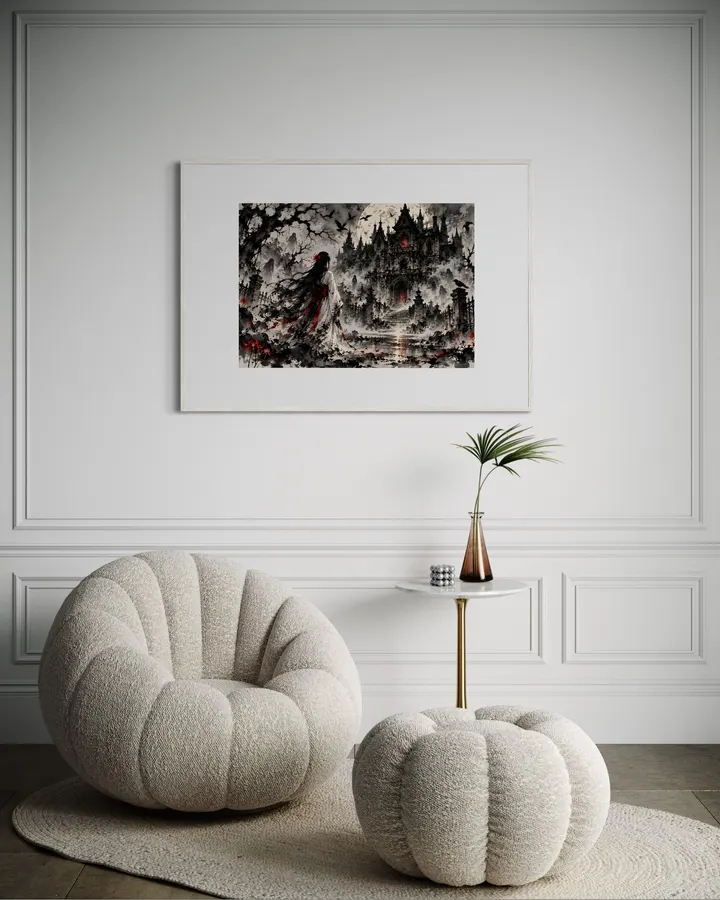
Beyond the mountains, where forgotten paths disappear beneath ancient trees, an abandoned shrine waits in absolute silence. At its entrance stands a solitary young woman dressed in a flowing white kimono. Her pale figure seems almost untouched by the darkness surrounding her, yet something about her presence feels deeply unnatural. Long black hair drifts around her face and shoulders despite the stillness of the night, stretching into the surrounding ink as though it belongs to the shadows themselves. Behind her rises an enormous torii gate, painted in dense strokes of black sumi ink. Its weathered structure gradually dissolves into mist until architecture, forest, and darkness become almost impossible to separate. Farther inside the fog, several faint silhouettes appear. They have no recognizable faces. No clear bodies. Some seem impossibly tall, while others are barely more than stains within the diluted ink. Whether they are spirits, memories, or simply shapes imagined within the darkness remains uncertain. Above the shrine, a pale moon emerges through untouched space, illuminating the landscape without warmth. Ink bleeds outward around its edges like gathering storm clouds, while splashes and descending trails of black pigment give the entire scene an unstable, almost living quality. Only a few traces of crimson interrupt the monochrome world: the woman's obi and several autumn leaves caught in an invisible current. The contrast feels strangely beautiful. Traditional Japanese ink-wash aesthetics meet supernatural folklore and psychological horror, creating a scene where emptiness becomes as important as detail. Every shadow seems capable of hiding another figure, and every uncontrolled stroke of ink suggests something waiting just beyond recognition. Perhaps the woman is visiting the shrine. Or perhaps she has been waiting there for someone to arrive.
High-quality giclée printing using 12-color pigment inks and 0.35mm fine art paper. Faithfully reproduces the texture and brushstrokes of the original work, with lightfastness of approximately 200 years.
Orders placed by noon ship the same day. Enjoy new art in your space without delay.
Beyond the mountains, where forgotten paths disappear beneath ancient trees, an abandoned shrine waits in absolute silence. At its entrance stands a solitary young woman dressed in a flowing white kimono. Her pale figure seems almost untouched by the darkness surrounding her, yet something about her presence feels deeply unnatural. Long black hair drifts around her face and shoulders despite the stillness of the night, stretching into the surrounding ink as though it belongs to the shadows themselves. Behind her rises an enormous torii gate, painted in dense strokes of black sumi ink. Its weathered structure gradually dissolves into mist until architecture, forest, and darkness become almost impossible to separate. Farther inside the fog, several faint silhouettes appear. They have no recognizable faces. No clear bodies. Some seem impossibly tall, while others are barely more than stains within the diluted ink. Whether they are spirits, memories, or simply shapes imagined within the darkness remains uncertain. Above the shrine, a pale moon emerges through untouched space, illuminating the landscape without warmth. Ink bleeds outward around its edges like gathering storm clouds, while splashes and descending trails of black pigment give the entire scene an unstable, almost living quality. Only a few traces of crimson interrupt the monochrome world: the woman's obi and several autumn leaves caught in an invisible current. The contrast feels strangely beautiful. Traditional Japanese ink-wash aesthetics meet supernatural folklore and psychological horror, creating a scene where emptiness becomes as important as detail. Every shadow seems capable of hiding another figure, and every uncontrolled stroke of ink suggests something waiting just beyond recognition. Perhaps the woman is visiting the shrine. Or perhaps she has been waiting there for someone to arrive.



Your cart is empty