


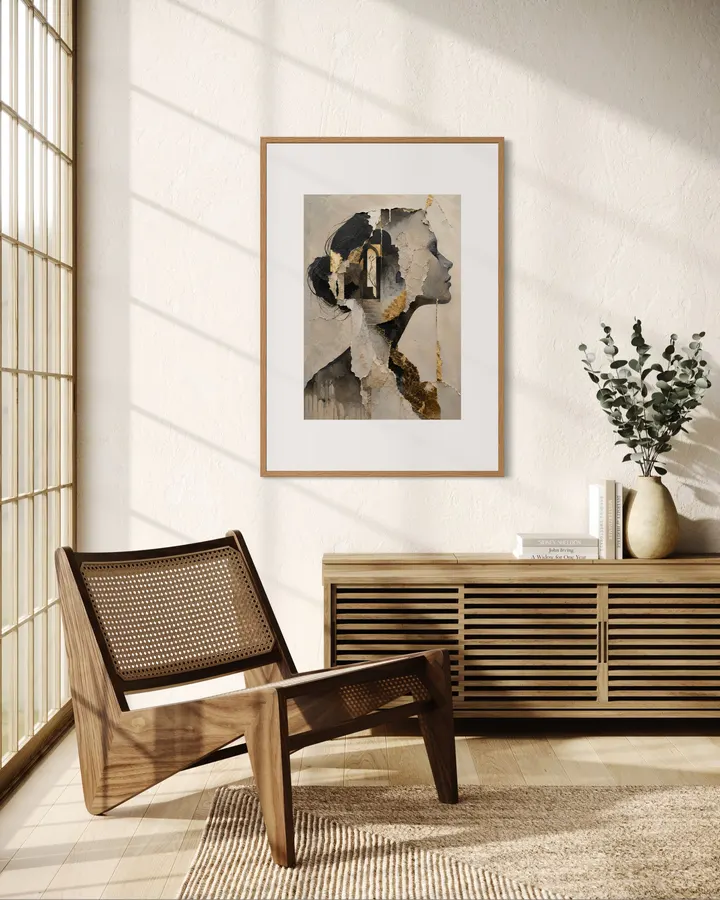
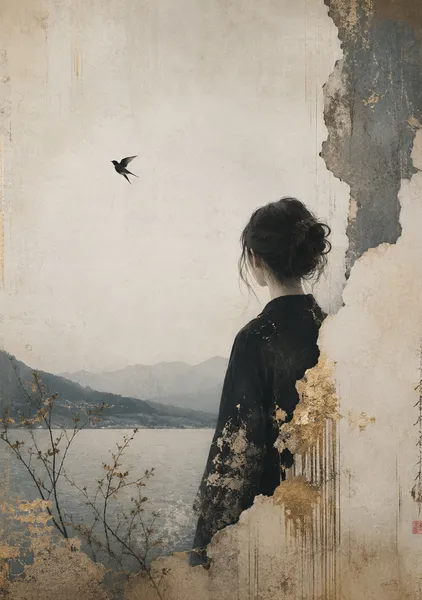
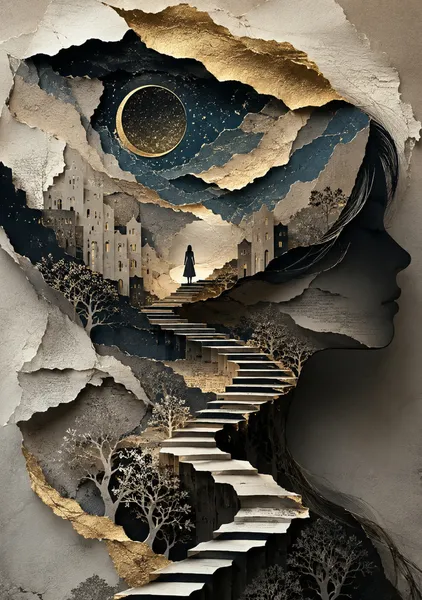
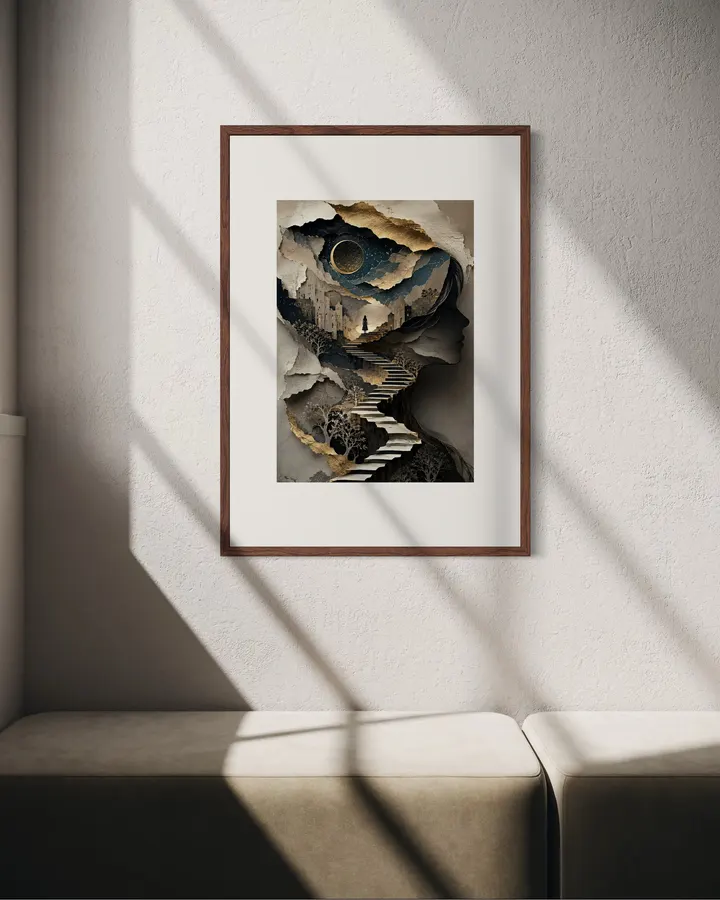
Do we fade away from the things we forget? Or does a "room" linger on somewhere, even after the forgetting is done? A quiet surface of raw linen and ash-grey. Where it peels away, stairways, trees, dim spaces, and scattered fragments of a scene emerge from behind the outline of a figure. This work does not tell a single, definitive story. The flaking surface reads like memory slipping away; the staircase descending inward looks like a doorway to the past, or a passage toward somewhere not yet reached. The composition dwells less on the figure itself than on **what has been left behind inside it** — a quiet, persisting presence. Drawn close, you find cracks, peeling, layering, abrasion, and the borders between strata — textures that call to mind paper and plaster. Step back, and those fragments reassemble into a single human form. The muted gold was placed not as ornament, but as traces of rifts, thresholds, and layers that have been lost. Where, exactly, is "the room that remained"? Inside a memory? Inside someone? Or in a place that no longer exists? This work leaves the question unanswered — a deliberate open space (余白, yohaku: the meaningful emptiness that invites the viewer's own interpretation) where meaning shifts with each person's own remembering. ※ The paper, plaster, and metallic textures, as well as the sense of dimensionality in this work, are visual effects rendered on a flat surface. They do not indicate the use of actual gold leaf or physical raised relief.
残された部屋|The Room That Remained— The Room That Remained
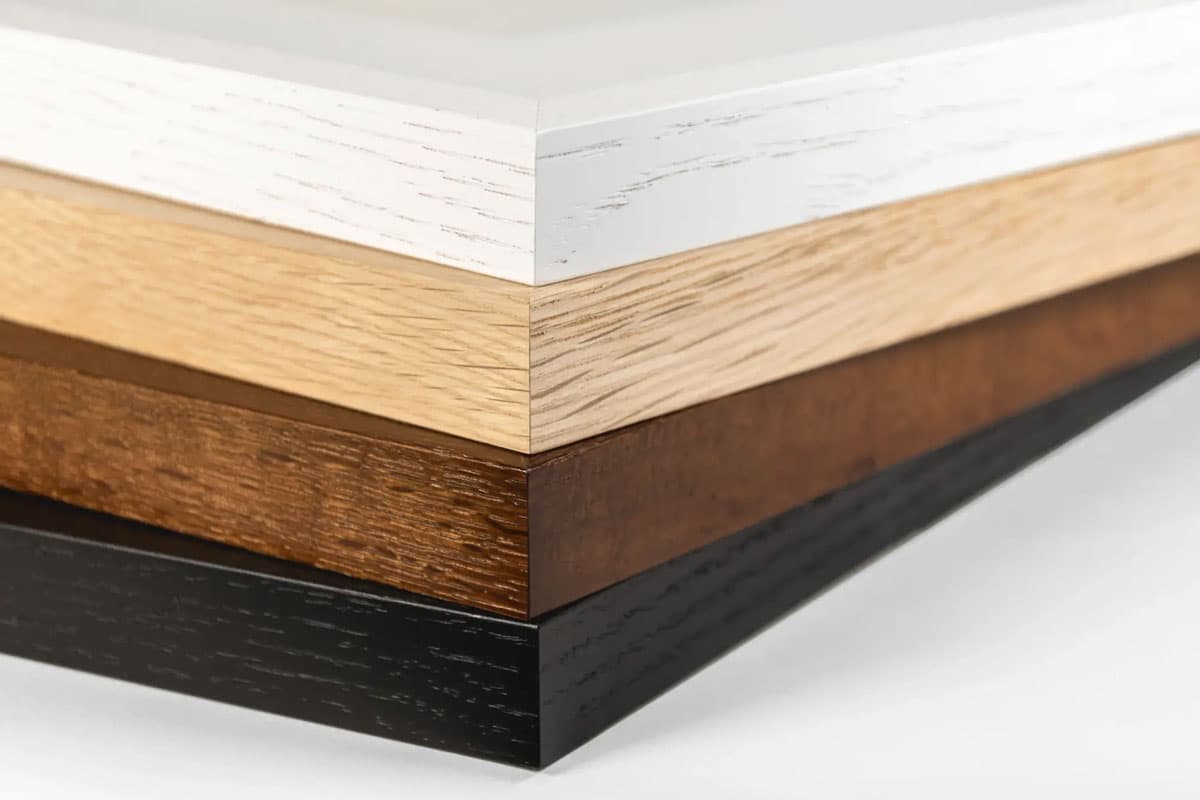
High-quality giclée printing using 12-color pigment inks and 0.35mm fine art paper. Faithfully reproduces the texture and brushstrokes of the original work, with lightfastness of approximately 200 years.
Orders placed by noon ship the same day. Enjoy new art in your space without delay.
Do we fade away from the things we forget? Or does a "room" linger on somewhere, even after the forgetting is done? A quiet surface of raw linen and ash-grey. Where it peels away, stairways, trees, dim spaces, and scattered fragments of a scene emerge from behind the outline of a figure. This work does not tell a single, definitive story. The flaking surface reads like memory slipping away; the staircase descending inward looks like a doorway to the past, or a passage toward somewhere not yet reached. The composition dwells less on the figure itself than on **what has been left behind inside it** — a quiet, persisting presence. Drawn close, you find cracks, peeling, layering, abrasion, and the borders between strata — textures that call to mind paper and plaster. Step back, and those fragments reassemble into a single human form. The muted gold was placed not as ornament, but as traces of rifts, thresholds, and layers that have been lost. Where, exactly, is "the room that remained"? Inside a memory? Inside someone? Or in a place that no longer exists? This work leaves the question unanswered — a deliberate open space (余白, yohaku: the meaningful emptiness that invites the viewer's own interpretation) where meaning shifts with each person's own remembering. ※ The paper, plaster, and metallic textures, as well as the sense of dimensionality in this work, are visual effects rendered on a flat surface. They do not indicate the use of actual gold leaf or physical raised relief.
Exceptional Quality
Similar in style





Cart
Your cart is empty